My process for completing assignment two was initially to read the assignment outline, then read and read again to be sure I fully understood what I was to do. For some clarity I contacted my tutor about work which could be included.
Secondly, I undertook research into visual presentations and how best to present the message I wished to convey to my audience. My audience I considered to be my tutor, students and those who are interested in the history of Nottingham and or it’s Lace Market district and those interested in the design decisions behind the Nottingham Contemporary.
Further to this I wanted to display a variety of the work I had completed/gathered, whilst ensuring it related to relevant information and provide a narrative.
Lastly, I considered my design which I wanted to link to the building. This took some working until I finally decided on my final piece. This is based on colours of the Contemporary’s exterior, the angled walls, which I have referred to throughout my work on the Contemporary and I framed most of the images – like pictures in an art gallery.
I enjoyed the process, particularly as I was learning yet another skill – effective ways to present. Without feedback I am not yet sure I achieved this yet but it was helpful to consider it and play with different ideas. I feel I’m a little limited as currently I only have PowerPoint available, I expect it’s possible to create better quality presentations with a more sophisticated design package? I have however signed up for an adobe creative cloud course in July at which point I will purchase the software too.
The process has been valuable in furthering my knowledge and skills in; visual presentation, design styles and decision making – considering the most valuable and relevant visual and written information to provide.
One thing I’ve found disappointing about the process is that there is no assessment criteria yet available to check against, even though the assessment guidance tells students this is what we should do before submitting work to tutors? It worries me there will be key criteria which I have not quite hit the mark on.
I am pleased with the outcome but also feel it is a little basic and that it’s possible to achieve something much slicker and more minimal. This will probably take better software and more experience and confidence in design and presentation skills. When I was researching presentations, I enjoyed and admired those I viewed which were minimal yet conveyed their message well. I did not feel confident enough to leave too much information or images out, in order that I display a variety of work.
With continuing learning, skills and knowledge I hope one day to achieve the look and quality of some of the presentations I viewed – and create something minimal while effective.
I expect to incorporate this process in continuing practice
in may ways; creating mood boards, presenting design ideas to clients and creating
a portfolio of work.
If vernacular architecture is to do with issues around sustainability both environmental and economical – and to produce contemporary, innovative buildings that explore and borrow methods, materials and techniques from the past I would suggest that a CobBauge building, a material which I researched for exercise 2.3 is a good example of vernacular architecture.
Fig 1.
CobBauge brings the natural material cob up-to-date ensuring it meets building regulations and environmental standards while being a sustainable economical product, sourced from materials in the area the building is to be built on.
Further examples of vernacular architecture are those shown below by Birdsye Design. Birdseye Design are an American architectural firm which states that it has an ‘architectural language which draws from region, heritage and context’ (Birdseye, 2017). This would suggest a vernacular language and with their strong commitment to woodworking and artisan work would suggest a connection to past skills and methods.
Their projects link to the regions historic architectural styles.
Fig 2.
Dorset Mountain Home is a contemporary building which draws
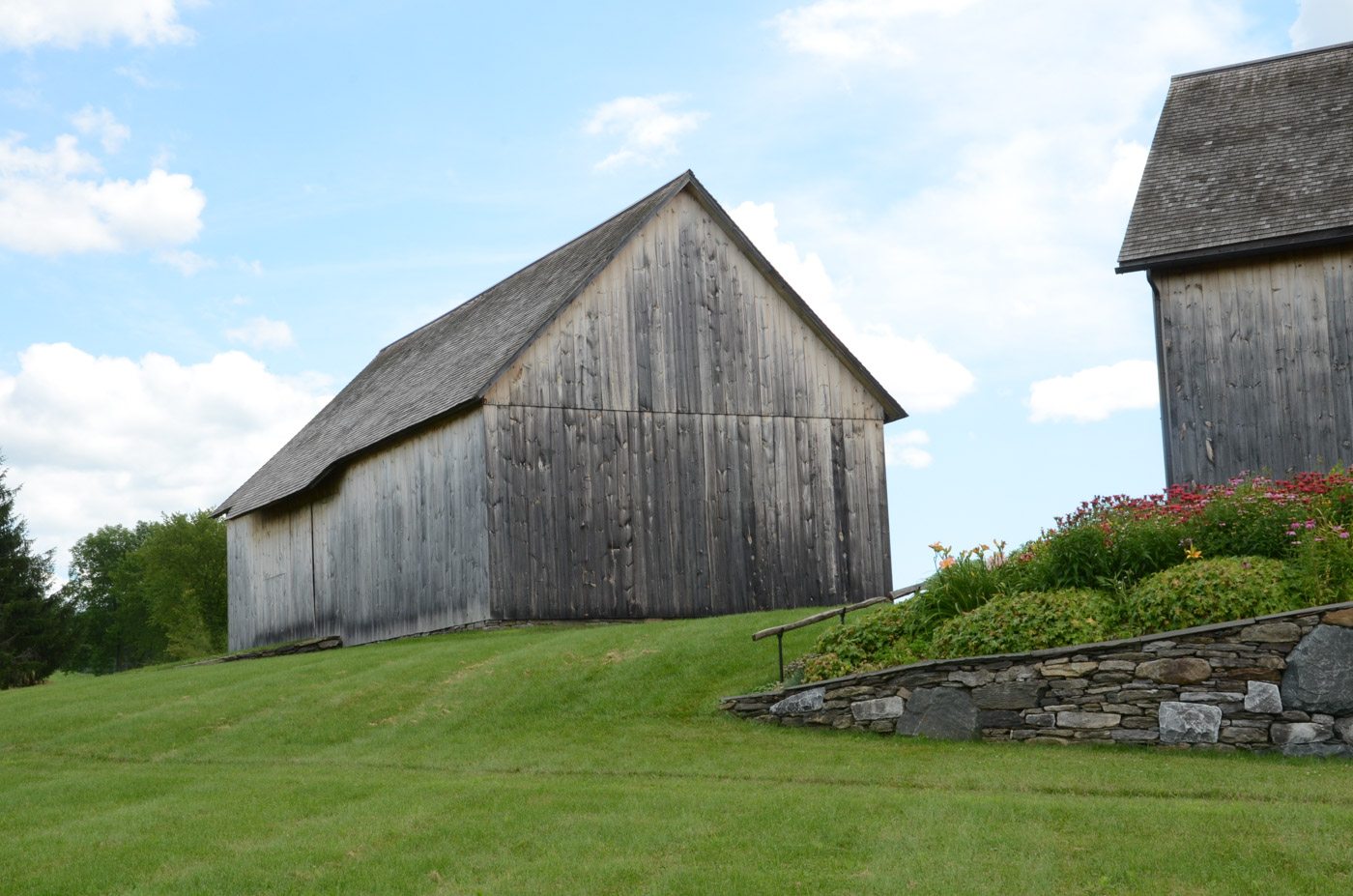
on the steep gable barn roofs of Vermont, where the house is situated.
Below is Board + Batten Guest House named after the traditional board and batten exterior panelling of homes in this region, also in Vermont.
Fig 3.
Further examples are contemporary homes in the highlands and islands of Scotland which are being built with respect to the traditional style of this region. In areas like these there is a close relationship between people and the environment and the homes are designed to fit in and not take from or jar with the environment around them.
Fig 4.
Architectural firms such as Dualchas and Rural Design are
ensuring homes are being built which consider ‘design elements like social,
economic and environmental sustainability’ (The Culture Trip, 2019)
Fig 5.
Fig 6.
Black house on the Isle of Skye is designed by architects Rural Design. Black House is built into a hollow between two drumlins, this shields it from the high winds on the island, whilst not detracting from views in the area.
The buildings form and exterior black cladding is inspired from the traditional agricultural buildings which are dotted around the landscape. The building is designed to be sturdy and efficient.
Fig. 7. Traditional agricultural builindg
The architects state that ‘the house is truly a black house, not only by it’s colour but by it’s very spirit. It draws parallels to the can-do attitude of the original occupants of blackhouses, heroically self-built using materials and skills to create a shelter for the family’ (Rural Design, 2016). I believe this epitomises modern vernacular, built with regard to the local landscape, materials, environment and people, whilst being economical and sustainable.
Vernacular Architecture in my village
I live in Oxton, a rural Nottinghamshire Village which was first mentioned in the Doomsday book.
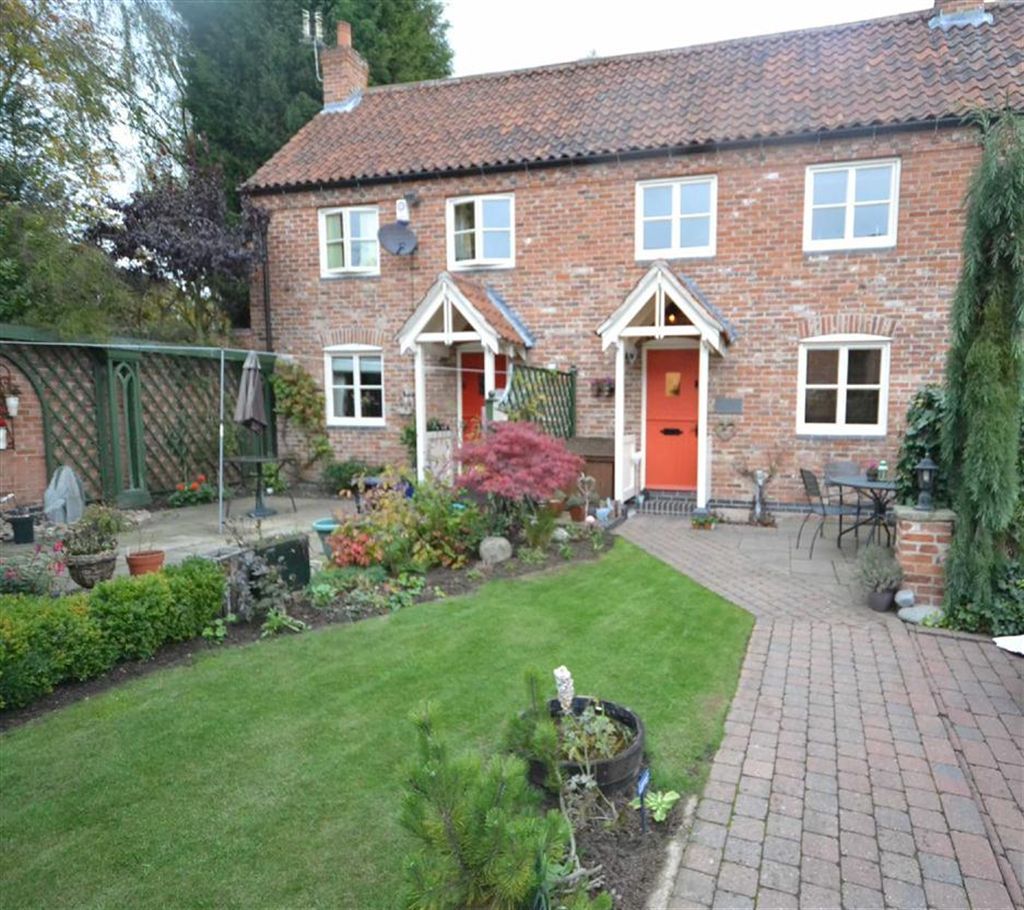
There are a variety of buildings of different ages and styles in the village but the traditional vernacular architecture is very much red brick buildings with pantiled roofs. Such as the 18th Century Manor House which also displays gothic glazing bars.
Fig 8.
The Church of St. Peters and St. Pauls however dates back from the 12th century with restoration taking place in 1898. It is a listed building with its listing stating it is built of Ashlar dressed rubble with a slate roof. Ashler being a finely cut stone, usually in a cuboid shape.
Fig 9.
As it is a rural village many of the buildings are farm buildings, most of which have been converted into homes, again displaying the traditional red brick and pantiled roofs.
Fig 10.
As the village has grown and modernised the building style, whether grand or affordable housing has continued to be sympathetic to the traditional style of building materials, with some modern buildings continuing to be designed with Georgian style windows.
Fig 8. (2011) [photograph] Murray-Rust, A. (n.d.). The Manor House (C) Alan Murray-Rust. Geograph.org.uk. At: https://www.geograph.org.uk/photo/1629233 (Accessed 29.03.19)
Ruraldesign.co.uk. (2016). Rural Design Architects – Isle of Skye and the Highlands and Islands of Scotland. [online] Available at: https://www.ruraldesign.co.uk/ (Accessed on 29.03.19)
Williams.gen.nz. (2001). A Brief History of Hosiery Manufacture and Lacemaking in Nottingham.. [online] At: http://www.williams.gen.nz/hosiery.html (Accessed on 20.03.19)
The Nottingham Contemporary’s entrance sits on High Pavement in the conservation area of the Lace Market in Nottingham City Centre.
The Nottingham Contemporary is built on a cliff, with entrances to the building on three levels. The main entrance sits on High Pavement ground level, the level on which the galleries are situated on.
The public can enter and exit at two points in the building, High Pavement, east facing and through the café bar, south facing on the mezzanine level, which exits onto the lower yard. Also to the south in the basement level which is situated at the end of cliff road is the vehicle and works entrance. This entrance provides space for lorries to back into the building to unload and load.
The buildings main purpose is an exhibition space for contemporary art, which is displayed in galleries 1-4. In other areas of the building there are workshop spaces, offices and an events space which can provide, music, theatre and cinema.
The space within the galleries provides a good expanse of height and width to accommodate a variety of exhibitions.
Approximate dimensions
Existing buildings adjacent to the sight, north facing
There are a number of buildings surrounding the Nottingham Contemporary. The north face of the building has a large expanse of open space as it looks out onto Weekday cross. The buildings facing the Contemporary on weekday cross are mainly cafe’s and restaurants, which are at an angle to this face of the building and look out onto gallery 4’s window. The offices to the west sit across and slightly back from the wide expanse of Middle Hill road, although they overlook the west side of the Contemporary there are no windows on this side of the building.
Existing buildings adjacent to the sight, north east facing
To the north east of the main entrance, sitting along High Pavement, is a long row of converted historical buildings, which consist of mainly restaurants, cafe’s and bars. These buildings have a view onto the north window and entrance and upper yard window. These buildings have little influence over internal views but link the building to the lace market to which it’s structure is influenced.
Existing buildings adjacent to the sight east facing
To the east lies the imposing converted Unitarian Church, which is now a restaurant/bar. It has high level stained windows, which do not provide views onto the Contemporary and its entrance sits back from the road and from the boundary of the Nottingham Contemporary upper yard. The upper yard area and parts of Garnet Hill steps – with views into the contemporary’s large landing window – can however be viewed from the outside seating areas of the church.
Internal sightlines
The sunpath allows the Contemporary’s main entrance to have early sun to after midday. Before, during and after midday the best of the sun is focused on the lower yard, where the café seating spills out onto when the weather permits. The north and east facing buildings are not too close to block the sun from the buildings windows and the south facing windows on the café and project area have no buildings overlooking the Contemporary.
The main materials in The Nottingham Contemporary galleries are; wooden floors, plaster walls, glass and the materials from which the ceiling/window structure is made from – what material this is I am not entirely sure?
Wooden Floors
The wooden floors in the Nottingham Contemporary provide a very mellow element to the galleries. The tones in the wood are soft natural tones of yellow, orange and brown, with varying shades of grey in the grain and between the boards. The floors are used throughout the galleries which provides a flow through the building.
The wood appears flat and smooth but it is far from one dimensional. The shape of the boards themselves provide pattern and direction. Looking more closely the differing grain of every board provides a natural beauty and texture.
I am not certain what type of wood it is but would take a guess at oak and also that it is a solid wooden floor. Solid wooden floors provide the best sound absorption, this being another reason the floor appears mellow to me. As I sat at the entrance to the galleries I watched and listened as people entered, which acoustically was soft and gentle underfoot.
In areas where the floor has clearly had greater footfall the boards look greyer as the grains in the wood appear to merge together and become worn.
Plastered Walls
From a distance the plastered walls appear to be flat, matt white. Looking closely however their is a texture to the walls, there is a slightly bumpy texture, almost pock marked.
Although the walls are painted a matt white, again when taking more time to look they appear to emit different tones, sometime grey, blue or pink and provided an orange glow when light is reflected on them.
Glass
Although only one gallery has a window glass is used vastly throughout the building:
Gallery 4 and front of building – large glass window.
Entrance – large glass doors, internal and external and large window running across the reception area.
Galleries 1,2,3 – large glass doors.
Landing area between entrance level and lower ground level – large window
Café – large glass doors, window and window above in the project space, which is to the rear of the building.
Glass is not only used to bring in natural light and entice people into the gallery but it is constantly changing and manipulated with coloured shaped adhesive film to display messages and advertise.
Sometimes the film has colour added to prevent too much light entering a gallery and sometimes to allow the window to create it’s own work of art as light which streams through it provides a mirrored coloured reflection.
Unknown Material
The ceiling/light structures in the galleries are held on metal beams and partly made from what I imagine is Perspex, and not glass, but are constructed mainly from a material which I am not entirely sure what it is?
The diagonal shaped pieces have a slight shine to them, at times looking a little like laminate. The solidness of the pieces also have the quality of an Natural Acrylic Stone, like Corian and Hi-Macs products which I looked at in the previous exercise. Neither laminate or Corian I would however consider to be suitable or required for a construction like this.
Spending some time gazing up at the ceiling my final assumption is that the construction is made from pieces of plaster board, cut to shape and filled at the joins, painted with a soft sheen paint to appear like solid diagonal shaped forms.
Auguste Perret is a French architect with whom Le Corbusier pioneered the use of Beton Brut (Raw concrete) from which the term Brutalism comes from.
Brutalist architects valued the rawness of materials – promoting the “Truth to materials”
Beton Brut is a style which leaves cast concrete unfinished, displaying it’s imperfections, lines and seems which are imprinted during the formwork (casting process).
During construction, buildings built with Beton Brut have their structural methods exposed, exposing their frame and components which would usually be hidden from sight. Brutalist buildings were the forerunners to high-tech structural expressionism which display their steel skeleton on the outside.
Perret completed a number of buildings in this Brutalist style including the Church of Notre Dame near Paris and Théâtre des Champs-Élysées in Paris.
Church of Notre Dame
Théâtre des Champs-Élysées
An outstanding example of his work is St. Joseph’s Church, in the city of Le Havre, a city which Perret reconstructed after it was destroyed in the war and which is now a Unisco world heritage site.
St. Joseph’s Church, Le Havre
Below are highlighted examples of how Perret displays ‘Truth to materials’. The concrete is bare and un-perfected, with large concrete structural columns on display. Other components of the building are also uncovered expressing and honesty about the buildings construction materials.
Sebastian Cox
Designer Sebastian Cox uses coppiced wood to create furniture and house hold items, which often continue to resemble the tree from which they came.
From the image above we can clearly see the bark of the branches and the grain of the wood in the table top is clearly visible, not hidden with stain or paint.
Sebastian’s philosophy is that every piece of ‘wood is far too beautiful to throw away’ (Cox, 2019), thus he uses off cuts of wood to create small items, each displaying the natural grain and colour.
Cox is loyal to ‘Truth to Materials’ not disguising the material, it’s imperfections or how it is constructed.
Jurgen Mayer
Jürgen Mayer is a German architect responsible for the design and build of the Meteropol Parasol. One of the largest timber constructions in the world.
The Meteropol Parasol is an urban centre combining both commerce and leisure contrasting with the background of the medieval city of Seville in which it is constructed.
The Parasol is made from interlocking milled timber with a polyurethane coating which is held together with glue and steel connectors, all of which are on show. The materials used, which include a steel frame are clear to see, they are not faced with further materials to hide the connections between pieces of wood or where wood and steel come together.
I don’t believe that ‘Truth to Materials’ is Jurgen Mayers ethos in all projects but with the Metropol Parasol he lays his materials and components bare. It is clear that this structure is made from interlocking pieces of wood, not something which is generally used in a building and the joins and workings of a structure and not so often exposed.
Barbara Hepworth 1903 -1975
Barbra Hepworth was a sculptor who, with Henry Moore, ‘became leading practitioners of the avant-garde method of Direct Carving (working in the directly chosen material’ (Tate, 2019)
From the image below we can see her working directly with wood, the marks her tools make and the grain and texture of the wood.
Hepworth worked in a variety of materials, sculpting, welding and molding, creating sculptures which display the ethos of ‘truth to materials’.
Large and small form
Squares with two circles
Mother and Child
In each example of Hepworths work above we can clearly see the materials used to create her sculpture. Large and Small Form and Mother and Child are made from alabaster, displaying the minerals markings with their own imperfections. Although the pieces look like 2 separate pieces of stone there is no fixing methods to be seen as they are each carved out of one piece of alabaster.
Squares with two circles is cast in bronze, clearly shows the patina of the metal as well as the joins between the shapes. The squares themselves are not actually square, with the angles not being 90 degrees and a slight convex to the face. To me this would appear to demonstrate ‘truth to materials’, that she allowed the metal and forms to take shape without manipulating them into perfection.
Debbie Smith
In researching ‘Truth to Materials’ I have come across textile artist Debbie Smith. I believe Smith is using her medium with a ‘Truth to Materials’ attitude as she is using thread in it’s simplest form. She is not sewing or intertwining it with other fabrics so it becomes only a tool to hold fabrics together but putting it on display and not shying away from it’s imperfection of fraying.
Smiths constructing and fixing method is clearly visible. She plots her designs with pins which are then left in place to stretch and fix her thread between to create her ‘pin and thread drawings’. (Smith, 2011)
Referencing
Barbarahepworth.org.uk. (2019). Home | Barbara Hepworth. [online] At: http://barbarahepworth.org.uk/ (Accessed on 09.03.19)
Centre, U. (2019). Le Havre, the City Rebuilt by Auguste Perret. [online] Whc.unesco.org. Available at: https://whc.unesco.org/en/list/1181 (Accessed on 10.03.19)
Researching Norman Foster and the Reichstag has been an enjoyable task. I’ve hugely appreciated the learning from these exercises; to know and understand more about Norman Foster and his design ethics has been enlightening and intriguing. I have also felt quite humbled that I knew so little about such a prominent figure and his extensive portfolio of work. It has made me realise how little I know and how much I have to learn! I can say much the same about the Reichstag – prior to undertaking this work I knew little of its history and the design for it’s future.
Reflection on the task
I took some time to decide on the best design for the presentation and as I am currently limited to using PowerPoint I felt a little limited. I also struggled deciding how much text to add – I worry it’s too much but at the same time believe it gives a good overview of the history of the Reichstag? In the end I decided to use simple shapes formed in a cone, so that it relates to the dome. I also made the shapes transparent, as a link to the design brief using colours which link to the Reichstag and Foster.
Materials I have chosen to focus on for this exercise are Stone, Metal and Glass. Each were paramount in Wallot’s design as they are in Fosters but with glass used to a much greater extent and taking a higher ranking than in Wallot’s Reichstag.
Stone
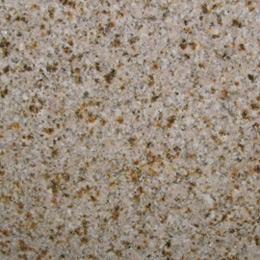
Stone, in this case granite is the main ingred ient of this building. It is the bones of the building, it gives it its great bulk and presence. It’s density and fire resistant qualities, no doubt what gave the building its strength and stam ina to stand the conflict it was put through.
Stone is not a material which Foster is known for creating new buildings with, he has however worked on numerous projects where historic structures have been restored or added to. Example of these are; of course the Reichstag, Chateau Margaux, Apple Champs-Elysees and HM Treasury.
2. HM Treasury
When rebuilding the Reichstag Foster wanted to bring stone from France, which he believed to be of superior quality. Foster however received pressure to use German Stone.
3. Original and new stone
In order to sense the history in the structure Foster has stuck to the original stone material and retained as much of the original building as is possible.
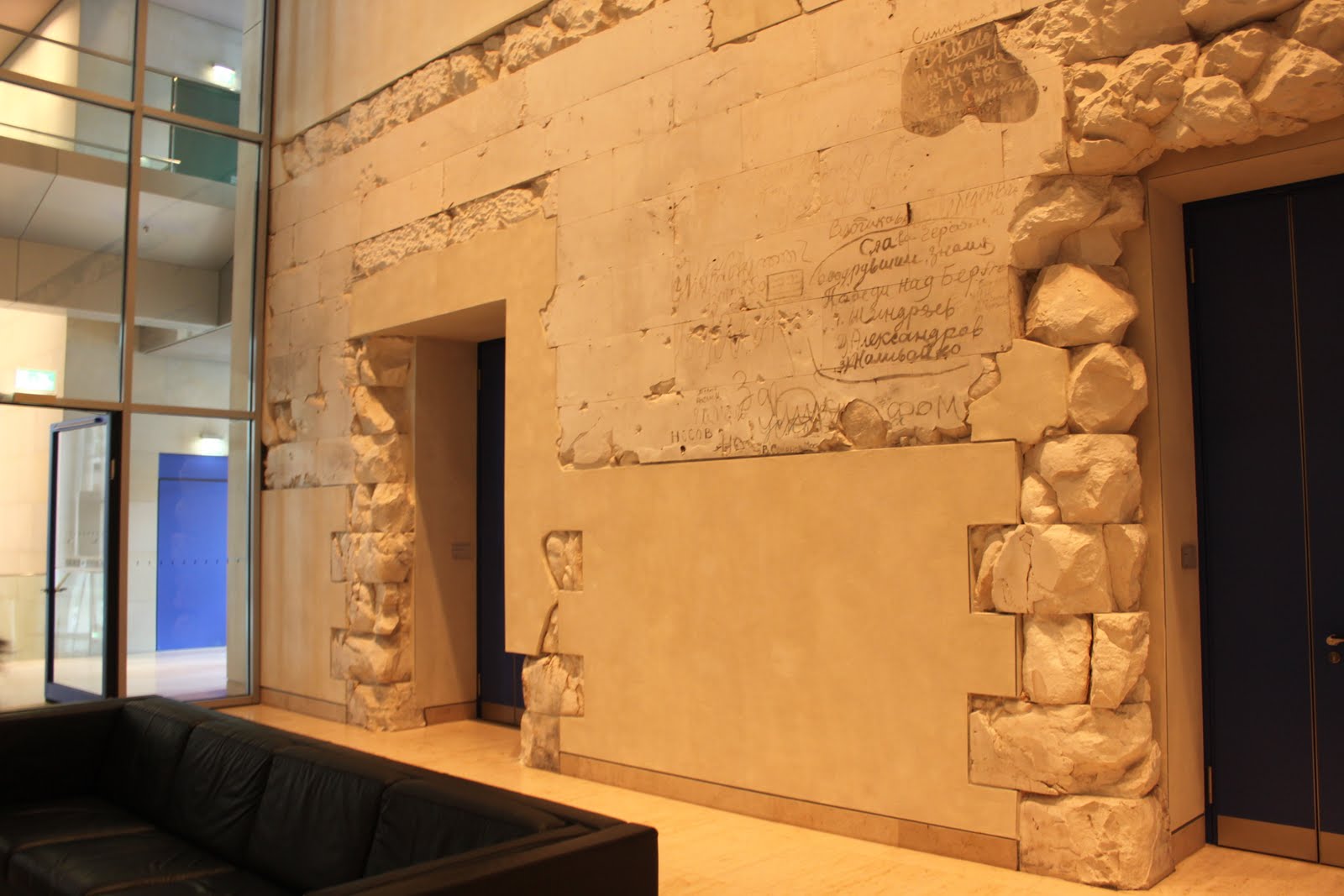
Although not entirely throughout the building, Foster has been sympathetic in his rebuild, maintaining as much of the original structure as possible and where ‘junctions between old and new work are expressed and where the existing fabric has been repaired the junction is clearly articulated’ (Foster, 2000: 77) This is done by leaving a small space (shadow gap) between the old and new as can be seen in the images.
4. Distinction between old and new
It is easy to spot new stone within the building, it is smooth and undisturbed in great contrast with the original which has been marked by it’s historic past.
5.
Glass
Glass has become the most Important of materials within the Reichstag. The most prominent glass structure being the cupola.
The glass and the cupola honor Wallot’s glass dome, but unlike Wallot’s dome, which was heavy and empty and could not be viewed from inside the building, Fosters glass dome is light in appearance and valuable in so many ways.
Glass is transparent and clear, exactly the message the German government wanted to give to their people, the reason Foster has used glass not just in the cupola but to a huge extent throughout the refurbishment. It provides views in and out and does not allow for secrets, much in contrast to Wallot’s compartmentalised darkly decorated interior.
7.
8.
9.
10.
11.
Glass also permitted Foster to work to the sustainable and ecological brief, bringing a vast amount of light and heat into the building. Cells within the Cupola use light to produce electricity and the mirrors within the cupola produce heat, reducing the need for fossil fuels.
Glass is ubiquitous in Fosters projects, it allows him to provide the sustainable and ecological benefits that he believes every building should offer. It is not always the prominent material like we see with the Hearst Tower or Seagram building but it always has an important role to play. We have seen the use of glass on all the projects I touched on through my research but other good examples include the Apple Cotai Central project in Macau where layers of glass and stone are integrated to give the appearance of a translucent stone façade, which provides a still and tranquil atmosphere internally.
12. Apple Cotai Central, Macau
Mirrors
The light reflector within the cupola is made using mirrors which come together to create a huge lens which reflects light down into the chamber. It has been hugely effective due to there being no tall buildings surrounding the Reichstag so allows a full unobstructed sky to bring in light. By interacting within a number of other elements within the cupola the mirrors provide heat. The mirrors and the system in which they are part of allows sunlight to enter into the chamber or for the outside changes in nature to be sensed from the inside.
13. Mirrored cone
Earlier examples of mirrors in Fosters work can be seen in the Fred Olsen project set in a forest in Norway, mirrors were used to project skylight into the interior of the building. In the 1985 Hong Kong and Shanghai Bank Headquarters, with the creating of the sun scoop which brought light into the atrium and public plaza. In his 2018 Apple’s Champs-Élysées project Foster created a pyramid shaped solar roof, which reflects light on and into the building while also reflecting images of surrounding buildings.
14. Apple Champs-Élysées
Steel
Steel is a favoured material of Fosters, with the majority of buildings which I have looked at through this research being constructed of steel. It is what gives Fosters the ability to build sky scrappers such as the HSBC building and to create a structure to which glass can hang from effortlessly and almost unobstructed, such as the Supreme Court in Singapore.
14. Supreme Court Singapore
Wallots original dome structure was made from steel as is Fosters, but Fosters use of steel feels far more valuable, on show and useful giving the structure a much lighter more buoyant feel.
The structure of the dome was made from steel, constructed by German structural engineers. The structure weighs more than 800 tons but is created to look delicate with 24 curved ribs running from the top to the bottom of the dome to which the ramps are hung. Attached to the ribs are horizontal ringed beams, attached to the ribs by steel connectors and welded joints. The cone is then attached to the chamber ceiling using stainless steel cables. The Cupola is then attached to the building by piercing the ceiling of the chamber from where the chamber can be viewed.
The steel connects with the glass and mirrors, allowing the glass dome to sit gracefully on top. The steel then connects with the building as it is held in place and sits majestically, bringing all of these materials together in a considered and symbolic way.
Steel is used in other internal areas throughout the building such as window frames, handrails & staircases.
15.
16.
17.
18.
The image below displays how the contemporary, airy and luminous glass and steel structure contrasts while integrating with the heavy, robust and resilient stone of the past.
Civil Engineering Blog. (2016). Common Buidling Stones – Characterisitics of Building Stones. [online] At: http://www.civileblog.com/building-stones/ (Accessed o 05.03.19)
Foster, N. (2000). Rebuilding the Reichstag. Woodstock, N.Y.: Overlook Press.


 Lee's study journey